




Brief History: The German Military Ordinance Stamp was called the Waffenamt (WaA) or the German Army Weapons Agency. It was the Headquarters for all military research and development of Germany for weapons, ammunition and equipment to the German Military or Reichswehr and later called the Wehrmacht. The German Army Weapons Agency was founded in late 1919 as Reichwaffenamt (RWA), was renamed in May 1922 to the Heereswaffenamt (HWA), which in turn was renamed the Waffenamt in 1936 after the takeover of the Third Reich.
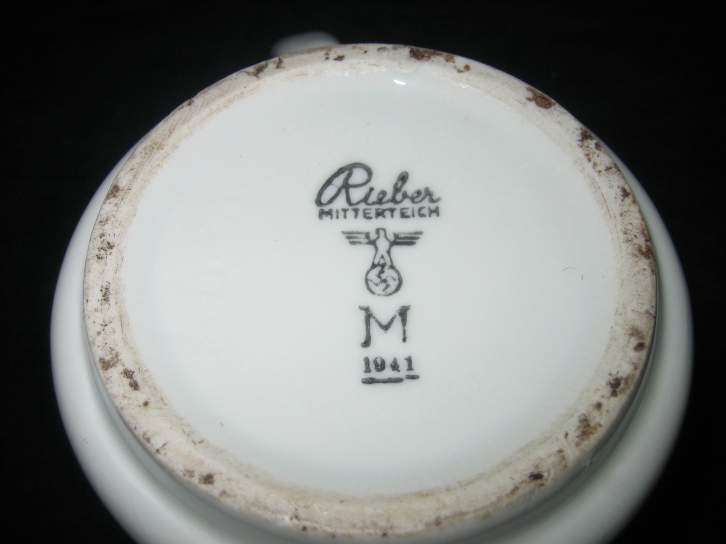
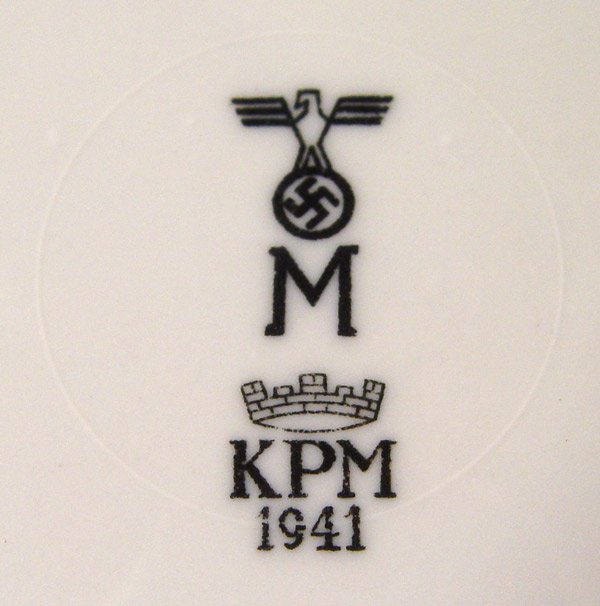
The above two photographs clearly illustrate the Third Reich Waffenamt used to identify items made for the German Navy or Kriegsmarine as found on a dinnerplate produced by KPM on the right and a coffee cup produced by Rieber on the left. Note how the Kriegsmarine Waffenamt's on both pieces are very similar in design and coincidentally manufactured in 1941.
Besides the typical manufacturer's bottom marks found on most china, all German Reichsmarine and Kriegsmarine Porzellan (German Navy China) also had Miltary Ordinance Inspection Stamps which consisted of a stylized German National War Eagle or Adler, Swastika and the capital letter "M" below the eagle. This "M" was an abbreviation for the German word "Marine" and translated into english meant Navy (ie; Kriegsmarine consists of two words, Krieg which means war and Marine which means Navy, or literally "War Navy").
These Military Ordinance Stamps were called the "Reichwaffenamt" under the German Weimar Republic between 1919-1922, then renamed the Heereswaffenamt between 1922-1933, and renamed between 1933-1945 to the shortened "Waffenamt" during the German Third Reich till it's defeat in 1945.
Between 1919 and 1933 the German Weimar Republic Navy, or Reichsmarine, used the Naval Reichwaffenamt and Heereswaffenamt consisted of a stylized Imperial German National War Eagle, or Adler, with a capital M below it, again for Navy.
The Third Reich Kriegsmarine Waffenamt consisted of a stylized stick-figure German National War Eagle (adler) with encircled Swastika, along with a capital M below it.
During the Third Reich between 1936-1945 all branches of the German Military (Wehrmacht) had their own stylized versions of the Waffenamt Military Stamp which are presented below so that the collector can quickly differentiate between a piece of dinnerware made for the German Navy (Kriegsmarine) versus a similar piece made for the German Army (Heer) or Airforce (Luftwaffe).

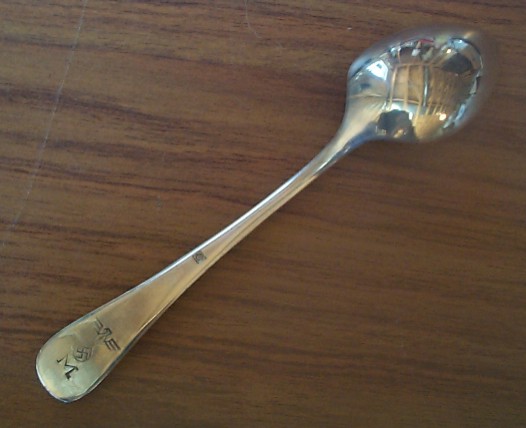
The spoons on the above two photographs illustrate the differences between the German Navy or Reichsmarine Reichwaffenamt on the left used between 1919-1936, and the Third Reich Kriegsmarine Waffenamt on the right used between 1936-1945.
The German Imperial Eagle, or Adler, used with the Reichwaffenamt was the same for all of Germany's military forces and what differentiated war material made specifically for the Kriegsmarine was the capital letter M. During the period of time when the Waffenamt was used the German National Eagle was slightly different for the Army, Navy, and Airforce which will be discussed below.
All German Dinnerware and Tableware was mass produced in various standardized designs and was sold commercially around the world. The only way to differentiate any piece of dinnerware or tableware as to whether it was made for the general public or for the military was whether or not the item had the Reichwaffenamt or Waffenamt.
If you find a piece of china, silverware or holloware being offered or being advertised as "authentic german military" and it does not have the required GErman Military Ordinance Stamp then it probably was made for and sold commercially to the general public. There is no other way to differentiate military from non-military items between 1919 and 1945.
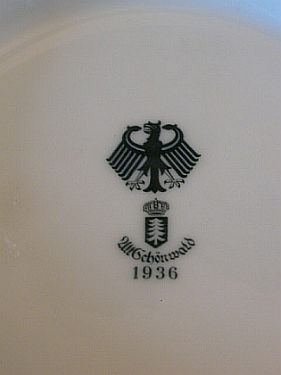
The above two photographs clearly illustrate not only the German Military Reichwaffenamt used between 1919 and 1936 but also the differences between the German Army stamp and Reichsmarine Navy stamp with the added "M".
The photo to the left is from a coffee cup made for the German Imperial Army, while the photo to the right is from a dinner plate made for the German Imperial Navy both dated 1936 from different china producers.
In general, besides the capital "M", it appears that the German Eagle itself found on the Reichwaffenamt differ slightly on china pieces made the Army and for the Navy. Note that on the Army Eagle the feet and the wings are outlined while on the Navy they are each filled in. We have found this to be true on almost all of the china pieces we have seen or collected.
Above photo to the left illustrates a Third Reich Waffenamt identifying the cup as belonging to the German Air Force, or Luftwaffe. This Luftwaffe Waffenamt will always have the initials Fl. and UV. which stand for "Flieger Unterkunfts Verwaltung" which in english literally means Flight Barracks Administration.
Above photo to the right illustrates another similar but slightly different Third Reich Waffenamt identifying the cup as belonging to the German Army, or Heer.
Notice also the difference in the German National War Eagles or Adler for each of these two services as well as the difference of the German National War Eagle between them and the German Navy, or Kriegsmarine. All three are clearly different and differentiated from one to another. These differences are vital and critical in determining war material and articles manufactured for each of the German Armed Forces between 1936 and 1945.
 Above Photo Illustrates the same style cup from the same manufacturer, but the one on the left was made in 1942 for the German Army under the Third Reich showing the Waffenamt, while the cup on the right was made in 1936 for the German Army under the Imperial Wiemar Republic and using the Reichwaffenamt.
So in closing. For a German Military item manufactured between 1919 and 1945 that was used for the Navy it must have the appropriate Military Stamp which consists of the proper German National War Eagle for the period as well as the capital "M" which represents "Marine" or in english Navy.
Any German dinnerware or tableware that does not have the appropriate Reichwaffenamt or Waffenamt most likely was not produced for the German Military or Wehrmacht.
Below are links to other Antique Nautical and Naval Artifacts that may be of interest:
Click HERE for WWII US Navy Anchor China


 Or Click HERE to return to The Pirate's Lair Home Page and Gangplank!