John 5:24
"Home is the Sailor, Home From The Sea.... And The Hunter, Home From The Hill"

 Permission Granted To Come Aboard...
..And Welcome To The Pirate's Lair!
a Division of DataCity, Inc.
Click Here and Return to The Pirate's Lair Home Page www.thepirateslair.com
OR
Click Here and Return to the Naval Cutlass Main Page
OR
Click Here and Return to the Naval Boarding Ax, Boarding Pike, Pole Ax Main Page

Authentic American Federal and US Navy Boarding Pikes 18th-19th Century "Type I 1797" Leaf Blade and the "Type III" 4-sided Spike Patterns used During the War of 1812, Barbary Pirate Wars, and the American Civil War
The Pirate's Lair @ 540-659-6209
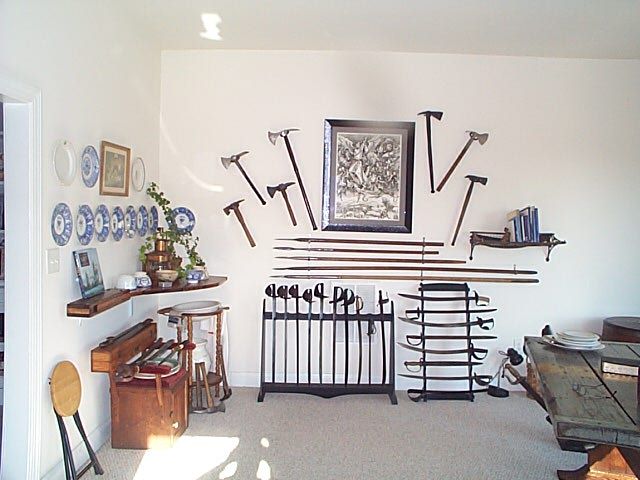
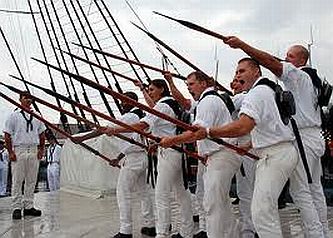
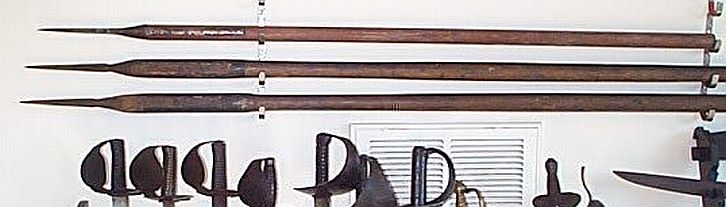
Photo above left shows part of the antique naval collection at The Pirates Lair: Note the 5 boarding pikes on the wall above the racks of naval cutlasses. The top 2 are American Navy and the bottom 3 are British Royal Navy.
From American Colonial through Civil War eras the American sailor regularly practiced repelling boarders with the boarding pike and there have been numerous mentions in official documentation and diaries as such.
Above photo to the right illustrates British sailors demonstrating how in proper drill practice how boarding pikes were used as defensive weapons against attacking boarders. Note how the boarding axes are worn located on theback of each sailor!
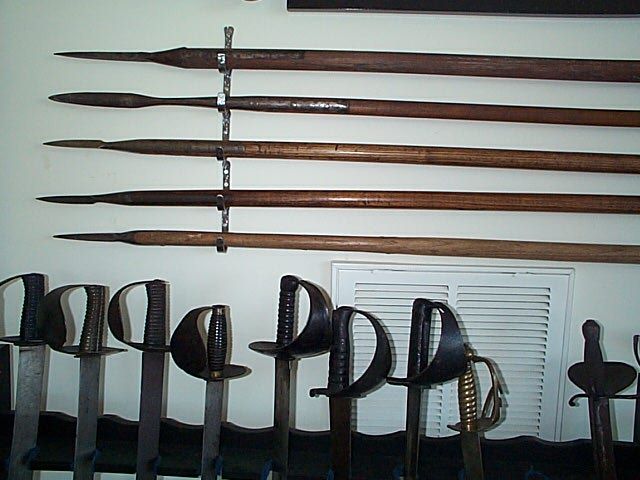
Photograph to the left illustrates five 18th/19th Century Boarding Pikes.
The top two are American and the bottom three are British boarding pikes. Note how the American pike heads appear to be a bit longer and narrower while the British pike heads appear to be a bit shorter and squatter.
All 5 models of these boarding pikes are documented in William Gilkerson's "Boarders Away" which is the industry standard in identifying naval cutlasses, boarding axes, and boarding pikes.
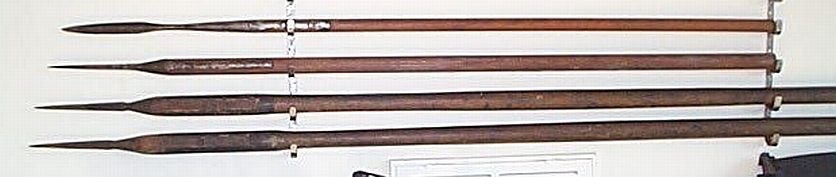
Above are four US Navy Boarding Pikes: Top is a Type I Leaf Blade, next one down is a Type III early model, and the bottom two are Type III's later models ca Civil War era.
Prior to the advent of a rapid firing pistol or rifle the Boarding Pike was used to effectively repel boarders as they were climbing up the side of a wooden hull or swinging into the raised defensive protective netting.
The major differences between a standard infantry spear or cavalry lance is that the boarding pike's total length of about 7' to 8' was a bit shorter than its cousins which were typically 9' and longer.
Above are three Type III Boarding Pikes - top is an early model (1800-1816) and the bottom two are identical later models (1860s)
The naval boarding pikes spike or blade itself was also thinner or slimmer than the spear or lance, and did not have any projections and was seamlessly smooth where it was fastened onto wooden shaft or haft. This was necessary so that the blade or spike could work its way through and not get caught up into any of the protective netting, associated rigging, any downed rope or canvas sail.
We here at The Pirates Lair utilize and refer to the fantastic work found in the reference guide "Boarders Away" by William Gilkerson. While we have added to our knowledge due to hands on experience with these boarding pikes and similar sea service weapons, we have never found Gilkerson to be wrong, ever.
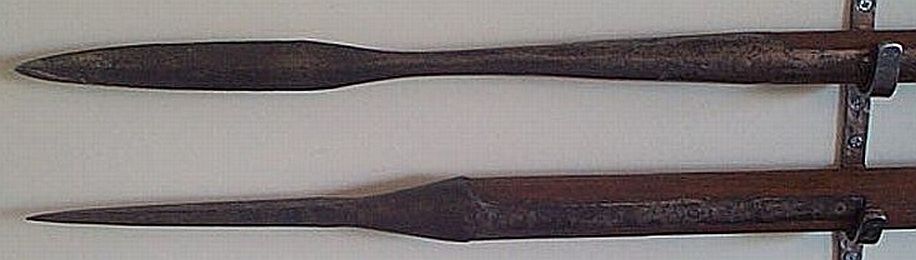
Above photo shows two American boarding pikes. The one on top is the Type I 1797 Pattern with leaf blade head (or very flattened diamond head) used throughout the Federal Navy period ca 1800 in the Barbary Pirate Wars thru War of 1812. And the bottom is a Type III model with a 4-sided spike head also used in the early 19th century and up through the Civil War.
BELOW ARE PHOTOS AND DESCRIPTIONS OF THE LATE 18TH CENTURY TYPE I 1797 "LEAF HEAD" AMERICAN NAVY BOARDING PIKE

Above illustrates the American Navy Model Type I 1797 Boarding Pike measuring only 60" or 3/4 of its original length. There is no reason as to why this was cut down, possibly due to damage at the butt end. The entire length of the wooden stave or haft is 1" in diameter and in general this boarding pike was relatively well made and finely crafted with attention to the details.


Above two photographs are closeups of the entire leaf blade and langets of the Type I 1797 boarding pike, and in general this was a very well made boarding pike. The thin leaf blade, or perhaps very flate diamond shape) is sharp along the edges with a thinly tapered neck before extending into two long langets. Each langet is secured with 3 large rivets going down the middle of the langet and two more smaller rivets at the end of the langet. The leaf head and langets almost appear as if they were hand hammered/welded together.

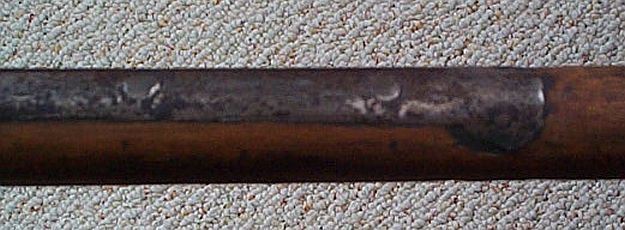
Closeup photos of the leaf blade and the bottom of a langet showing 2 of the larger securing rivets and the two smaller rivets at the end where the langet terminates into two tabs which wraparound the wooden stave providing for an even more secure attachment. It is this type of small detail which is an indication of a very well thought-out and constructed boarding pike.
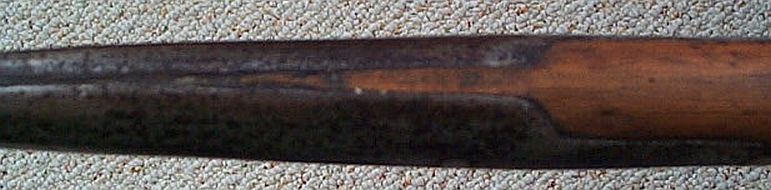
Closeup photo showing where and how the leaf head and langets merge into one piece.
BELOW ARE PHOTOS AND DESCRIPTIONS OF EARLY-MID 19TH C. AMERICAN FEDERAL and US NAVY TYPE III BOARDING PIKE (Early Type III)


An early version ca 1800 of the American Federal Navy Type III Boarding Pike - Note the lack of swelling or bulging of the wooden haft at the langets and any tapering handholds which is associated with the evolution of the Type III found later in its service life (1860s).
The haft on this particular piece was cut down to 60" making it a 3/4 pike. This was possibly due to damage to the butt end, warping, or shipment issues.
It has also been restored at some point in its post-service life, and when found it was being displayed on the wall of a private naval maritime club in the UK.


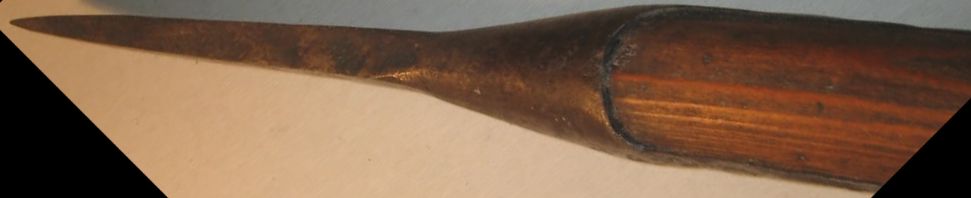
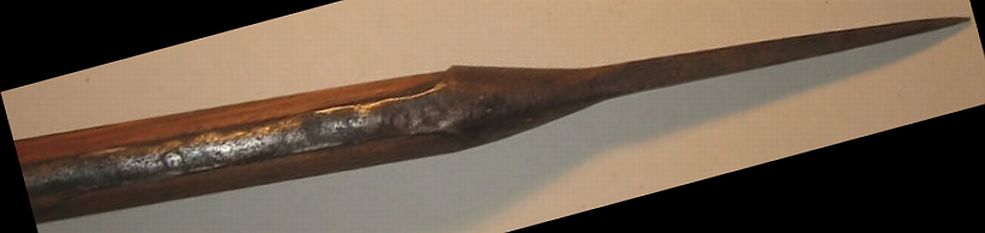


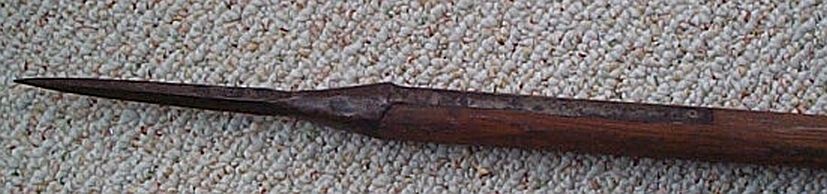
Close-up photo of the overall 4-sided square spike head: 7" spike head and 8" langets. Clearly an early model of Type III boarding pike as the wood where the langets are attached is not bulbous as in later Type III models (see below) where the entire pike bulged the entire length of the langets. This was to prevent the boarding pike from excessive penetration into its victim which was always a problem with naval pikes as opposed to infrantry or cavalry spears.
Unlike the American Model Type I 1797 the Type III boarding pike while well built was a bit cruder in its construction. This particular model of Type III as an early 19th century boarding pike has been well documented including its 60 year span of life and evolution from the very early 1800s thru to the Civil War era. Specimens of this Type III boarding pike have been found on sunken Federal Navy ships which participated in the War of 1812 with Britain thru to the American Civil War.
BELOW ARE PHOTOS/DESCRIPTIONS OF THE 19TH CENTURY AMERICAN US NAVY TYPE III BOARDING PIKE (Later Model Type III w/ Bulbous and Handhold features)

A later mid-19th century version of the American Federal Navy Type III Boarding Pike with a large "bulbous" swelling of the wooden haft where the langets are attached.
This bulbous swelling is an evolutionary feature found in late life models of the Type III boarding pike which prevented excessive penetration. Also note just past the swelling is a section of wood that tapers down and then tapers back up again. This tapering is actually a handhold, there is also another tapering about two feet further down the pike but not seen in this photo; this is a second handhold. The swelling and handholds are features only found in late model Type III's, ie; the Civil War period.
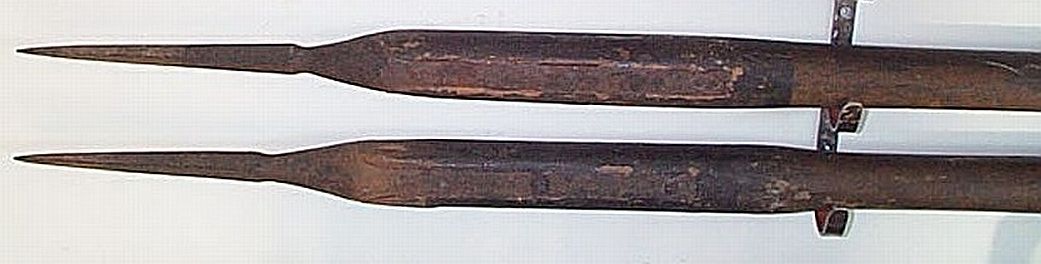
Both specimens in this collection are virtually identical with an overall 86" length, entire pike head of 17.25", 4-sided spike head of 7" and langets of 8". Original black paint on the pike head is still seen on the spike, swelled wood, and langets.
Also another feature not easily seen in the photos is that the wood haft about 12" below the langets has been turned in such a manner as to be a handhold of sorts: essentially the top portion of the wooden haft was made to have a bulge or swelling which then tapered to a 1.5" diameter for 18" down the haft, and then again tapered down for about 8" before tapering back up again for the full length of the stave. This tapered length of 8" appears to be a handhold to allow more force to be applied when using the pike to either push, pull or parry.

The Type III boarding pike stayed relatively consistent throughout its 60+ year service life with a 4-sided square head of substantial size and 3 riveted langets, and construction given to function over form (ie; somewhat crudely but well made). With the only additional features being the swelling and handholds previously mentioned.
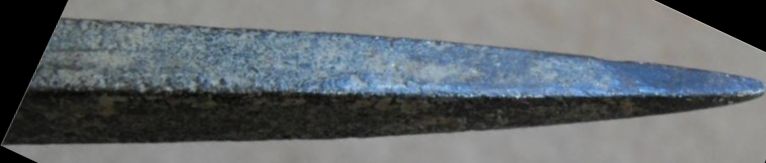
Tip of the Type III.
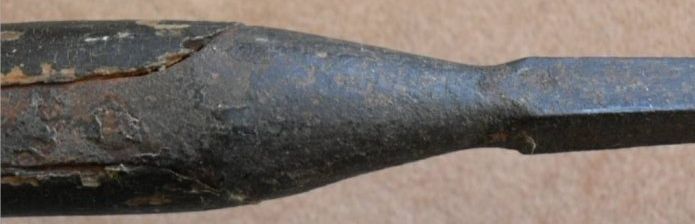
Illustrating the joint where the langets, spike head and socket meet.
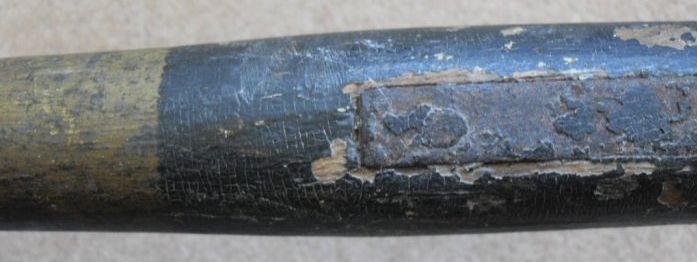
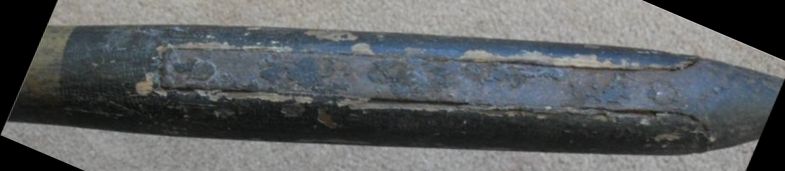
Note the bulge or swelling of the wood in the above two photos as well as the original black paint. This was an evolutionary solution to the age old problem of excessive penetration of naval boarding pikes.
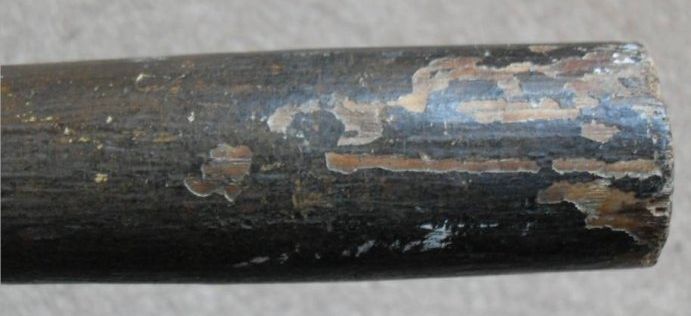
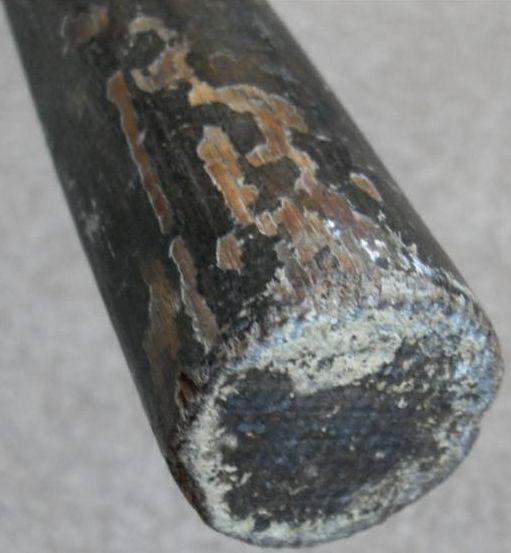
Photos of the butt end of the pike.
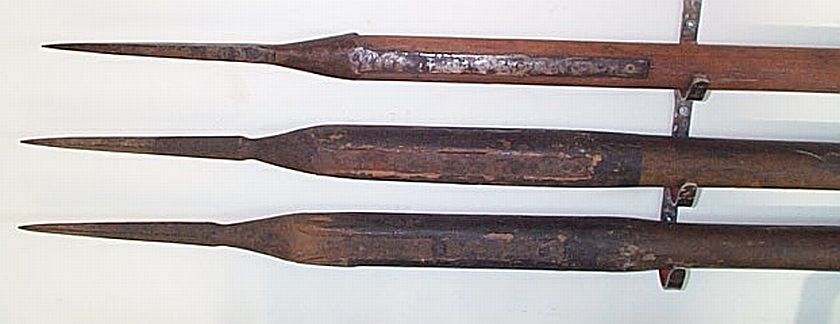
Just for comparison purposes above are illustrated both early and late model Type III US Navy Boarding Pikes. The top boarding pike is the earlier restored 3/4 58" Type III pike without the "bulbous" haft near the pike head and without recessed wooden hand grips. The bottom two are the later unrestored full length 86" model Type III's with both bulbous head and recessed wooden hand grips.
BELOW ARE BOARDING PIKES CURRENTLY AVAILABLE FOR SALE
Early-Mid 19th C. Civil War era Regulation US Navy Type III Naval Boarding Pike For Sale and Available
Rare chance to own a piece of Naval History! Authentic US Navy Regulation mid 19th Century Civil War era US Navy Type III Boarding Pike - Museum quality/Investor Grade specimen. |

Click Photo!
US Navy Type III |
86" Full Length |
$2295.00
Per Pike |
To Order Call
540 659 6209 |
Early 19th C. War of 1812-Civil War era US Navy Type III Naval Boarding Pike For Sale and Available
Rare chance to own an authentic piece of Naval History! Authentic early to mid 19th Century War of 1812 era restored Half-Length 58" US Navy Type III Boarding Pike with Regulation 4-sided pike head, langets, straight shaft or haft. Both the early and later models of Boarding Pikes were simultaneously used until inventory of the earlier models were depleted. - Museum quality specimen. |

Click Thumbnail Photo For Full Size Photos and More Information!
US Navy Type III |
58" 3/4 Pike |
$995.
SOLD! |
To Order Call
540 659 6209 |
British Royal Navy Model 1888 Naval Boarding Pike For Sale and Available
Rare chance to own an authentic piece of Naval History! Classic late 19th Century British Royal Navy Boarding Pike 60" stave or haft. The stave is 3/4 length which was presumably cut because of damage to the butt. Langet has clearly and properly stamped arsenal marks, Royal Victorian ciphers, and date of 1899. |

Click Photo!
British 1888 Pattern |
60" 3/4 Pike |
$995.
SOLD! |
To Order Call
540 659 6209 |
Below are links to other Antique Nautical and Naval Artifacts that may be of interest:
Click Here For Antique 19th Century British Royal Navy Mess Plates, Dinnerware, Rum Cups, Kegs and Mess Pails
Click HERE for WWII US Navy Anchor China
Authentic 100+ Year Old Nautical Antique Trunks
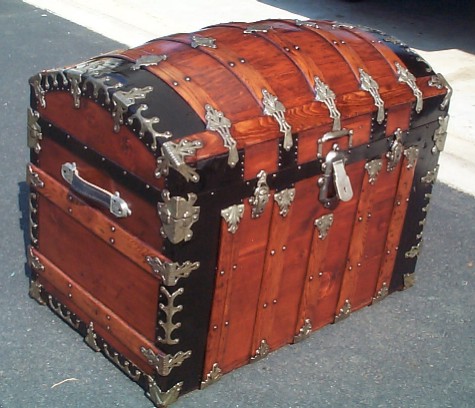
The Real Deal! Fully Restored Antique Trunks Like Sea Chests, Pirate Chests, Treasure Chests! |
Click Here To Review Sample Engravings |
The Largest Selection of Antique Trunks on the Net to Choose From! |
OPTIONAL - Trunk Wood Engraving Examples and Prices
Custom Designed, Handcrafted, and Hand Lettered in Caligraphy on your Antique Chest |
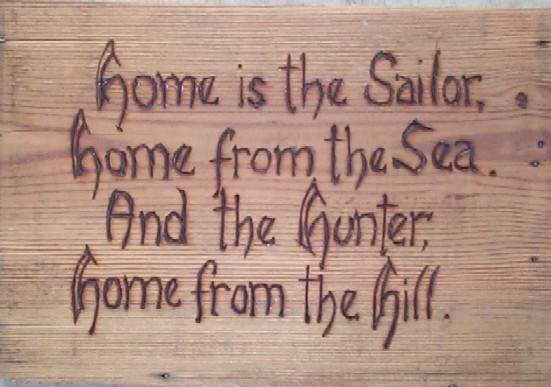
Click Here To Review Sample Engravings |
Personalize Your 100+ Year Old Antique Trunk in Perpetuity! |
Antique Trunks as a Shadow Box and Storage Chest!
Customer Photographic Examples of our Antique Trunks Being used as a Military or Naval Retirement Shadow Box and Storage Chest!! |
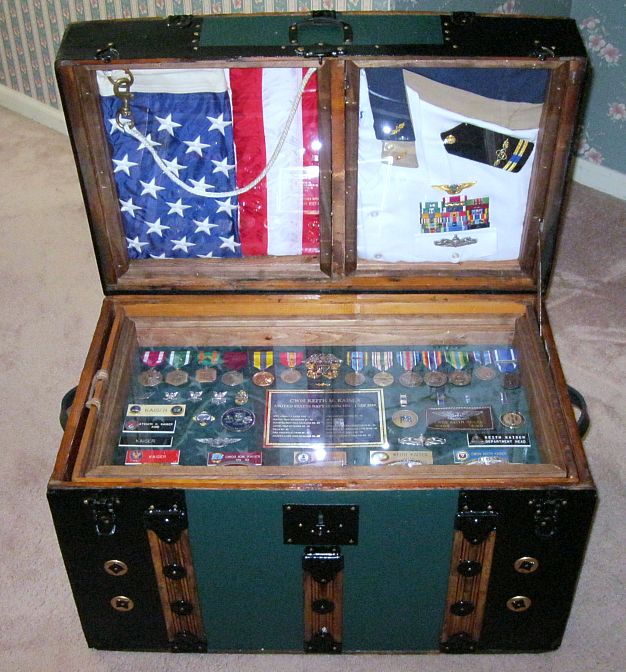
Click Here for Sample Shadow Box Photographs From Customers |
Why just get a shadow box or a newly made trunk with no history! One of our 100+ Year Old Nautical Antique Trunks can be used for both a Shadow Box and Storage Chest for your Uniforms, Photograph Albums, and Memorabilia! |
The Pirate's Lair
Division of DataCity, Inc.
78 Canterbury Drive
Stafford, Virginia 22554
Phone: 540-659-6209
Click Here and Return to The Pirate's Lair Home Page www.thepirateslair.com
"Service Disabled Veteran Owned Small Business"
Or
Email the-pirate@thepirateslair.com


 Or Click HERE to return to The Pirate's Lair Home Page and Gangplank!
Copyright(c) 2008 All Rights Reserved - Unauthorized downloading, copying or use of any html code, text or images found on this or on any other pages within the www.pirateslair.com website will be prosecuted.
Music Credits: Donald Where's Your Trousers/Drunken Sailor medley by The Bards
ANY TEXT BELOW THIS LINE IS SOLEY FOR THE BENEFIT OF SEARCH BOTS, SPYDERS AND OTHER DENIZENS OF THE DEEP DARK SEA INTERNET
The naval boarding pike was an indispensable part of a ships armament inventory for the deckhand.
One often sees pirates and sailors holding a cutlass in one hand with a boarding pike in another as they were used in conjunction with each other when boarding a naval vessel during a battle. The boarding as was used to clear ones own deck of debris including ropes and rigging which may have been shot away and fallen as well as digging hot shot out of wooden hulls, bridges, railings, decks, sails, etc etc.
The naval boarding pike as an offensive weapon was used to help a boarder climb up the side of an enemies wooden hull, then used to chop away at their rigging making it difficult or impossible for them to properly maneuver, and then to used as a personal weapon in close quarter combat. The boarding pike was also used to throw at an enemy to keep distance. In fact it has been said that a well thrown boarding ax was even more lethal than an early 19th century gun (both were equally only one shot!)