


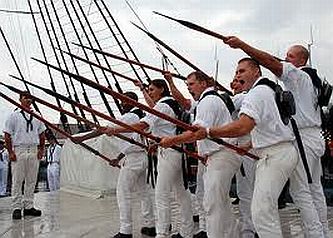
Note how the boarding axes are worn attached or hooked onto the backs of each of the sailors in the pike drill practice. Their black hats are covering the ax head, but you can see the wooden handle of the ax terminating in a ball.
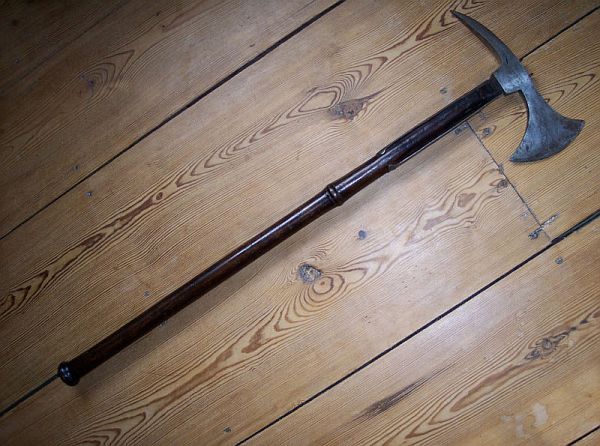
The naval boarding ax was the most indispensable and versatile weapon used aboard a naval vessel prior to the advent of propeller-driven steel-hulled ships of the late 19th century.
During the era of wooden hulled naval vessels powered by wind and sail the boarding ax was a critical piece of equipment used by the enlisted deckhand throughout a naval engagement from beginning the beginning shots of canon fire to the end when capturing or vanquishing an opponent.
Outside of the large bore canon and skilled seamanship of captain and crew the boarding ax was likely the most single most important weapon which would determine a ships survivability during battle.
Critical to a naval vessels survivability during an engagement would be to ensure that:
A) all "hot shot" was quickly removed and efficiently dug out from the hull, masts, or any wooden structure which it may have been imbedded preventing a catastrophic fire,
B) the rapid removal and discarding overboard of any downed rigging, ropes and masts which would prevent a vessel to properly navigate,
C) instrumental in allowing naval infantry or boarders to climb up the side of a wooden hull on an opposing vessel,
D) an effective weapon or sidearm used in close quarter combat either as a boarder or in repelling boarders.
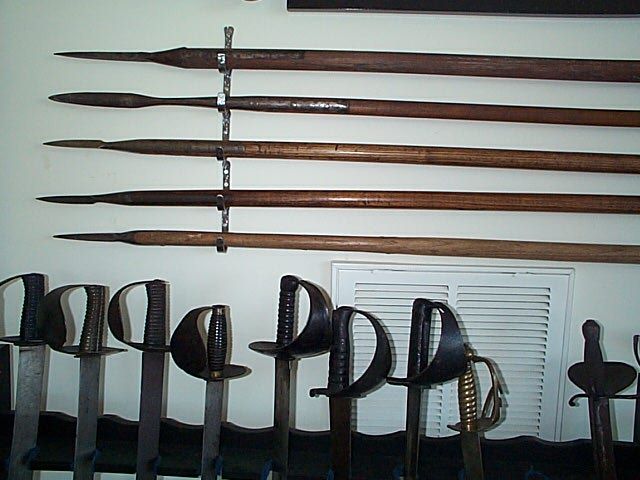
| Classic late 18th and 19th Century British Royal Navy Boarding Pikes in Museum Quality Condition with Original 91" and 92" staves or hafts. Photographic comparisons between American Federal Navy and British Royal Navy models, between the two British Navy models themselves, documenting stamped arsenal marks and royal ciphers. |
 Click Photo More Info! |
Edged Weapons for Sea Service For Sale and Available |
|
540 659 6209 |
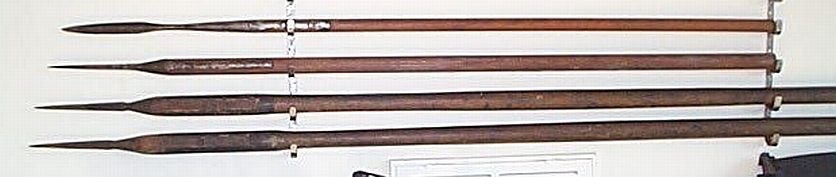
| Classic late 18th and 19th Century American Federal and US Navy Boarding Pikes in Museum Quality/Investment Grade Condition with Original 86" and 3/4 58" staves or hafts. Photographic comparisons between the American Federal Navy Type I and Type III models as well as evolving features found between early and later Type III issues. |
 Click Photo More Info! |
Edged Weapons for Sea Service For Sale and Available |
|
540 659 6209 |

Photo to the left illustrates a partial collection and representation of Scandinavian, European and British naval boarding axes and boarding pikes from the 18th and 19th centuries.
The Scandinavian and French boarding ax are very similar and distinctive with wide flaring blades and curved spikes, while the British boarding ax has a more traditional hatchet-type smaller blade and slightly straighter spike.
The 16th thru 19th centuries saw the culmination of the Naval Boarding Ax and Boarding Pike as vital defensive and offensive personal weapons as part of the inventory of a man-of-war. Both of which became obsolete by the beginning of the 20th century due to the advent of steel ships, small highly accurate personal multi-round firearms such as pistols and rifles, and of course highly accurate large-bore short and long-range naval artillery which would prevent close-quarter boarding.
From the Spanish American War onward there no longer came the need or even opportunity to board other vessels by climbing up the bulging wooden sides using the boarding ax, or the need to pick out "hot shot" rounds from wooden timbers and masts, or to drag and cut away ropes and sails taken down by canon fire, or to use the boarding ax to hack away or throw at an opponent.
Just as the enlisted naval cutlass was specially designed for close quarter combat by an ordinary seaman aboard a fighting vessel, as opposed to its landbased bretheren the sword; so was the naval boarding axe and naval boarding pike differentiated from its cousins the landbased military battle-axe and the halberd or pike.
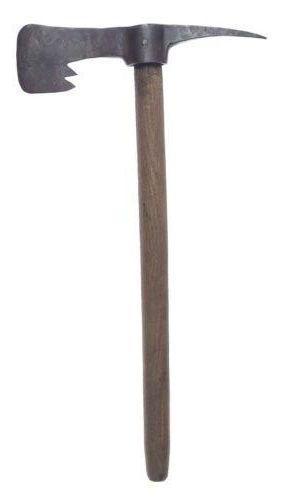
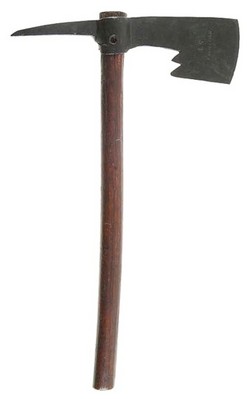
Above is an examples of a late 18th and early 19th century American US Navy Type I boarding axe which was very distinctive as to origin. The long bearded blade with large sharp cutout teeth were a completely American design to facilitate the gathering and dragging of fallen rope and sail.
In the day of wooden hulled and sail driven vessels there were typically no nails of any consequence used in the construction, so the teeth seen in these American-made naval boarding axes were not used to pull out nails. However the notches one sees in todays hatchets and axes which are used to pull out nails are a throwback to the original naval boarding ax.
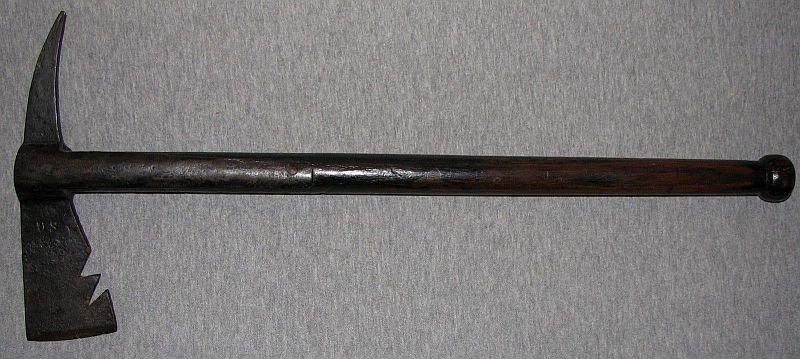
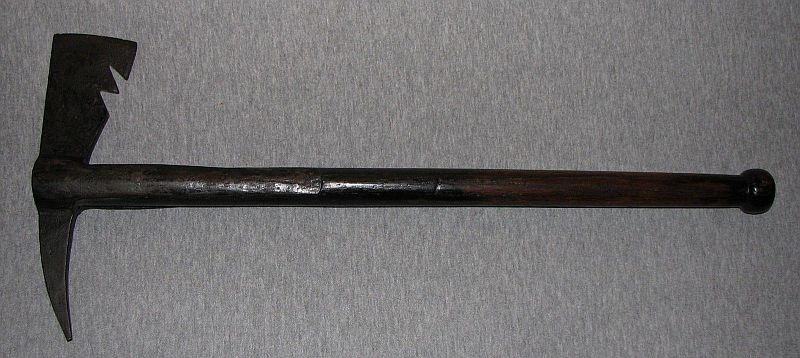
Above is an example of late 18th and early 19th century American US Navy Type II boarding axe with ball butt which is again like the Type I very distinctive as to origin. The single large sharp cutout tooth was a completely American design to facilitate the gathering and dragging of fallen rope and sail. Only the American Navy had adopted this very functional "tooth" and it can be found on all three types of Boarding Axes. Note that these teeth have even survived into todays hatchets and hand axzes and are used to pull nails.
Note that on the Type II the "bearded blade" with two teeth as found on the Type I was discarded in favor of a more traditional blade with one tooth. Also, the Type I did not have any supporting langets while the Type II incorporated side mounted hammer welded langets as an integral part of the socket. The Type II also had an iron wedge hammered into the wooden handle where it exited the socket. This model of Type II also had the monogram "US" stamped onto the obverse blade.
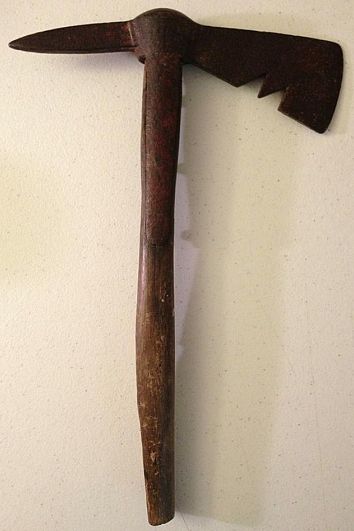
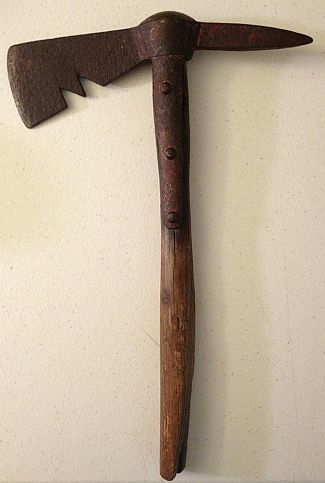
Above is an example of a War of 1812 American manufactured Type III Boarding Ax of the later modified models. Note that the "tooth" notched into the blade was now made to be a fixed feature of American boarding axes. The Type III boarding axes are typically arsenal stamped in 3 lines each letter with a separate die: "U.S. N.Y.W. J.T." (U.S. = United States, N.Y.W. = Navy Yard Washington, J.T. - Captain John Tarbell).
Captain Tarbell was a naval inspector at the Washington Navy Yard during the War of 1812 and his initials have been found on various naval ordinance including boarding pikes.
The Type III differs from the Type II in that the side mounted langets are not an integral part of the socket, but are separate pieces which are mounted thru the socket forming a small "cap" at the top of the socket, (similar to the French Hache Du Bord configuration). This was a significant improvement over the Type II and it appears that the US Navy took the best features of both British and French boarding axes and came up with its own distinctive design.
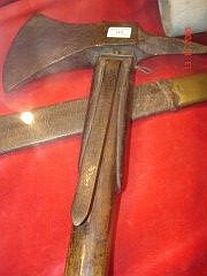
The photos to the left illustrate a French Model M1833 Hache du Bord or Hache Abordage naval boarding ax. Note the long fore and aft langets securing the axe to the shaft while there is an extra langet acting as both a belt hook and a protective shield for the wood against a cutlass thrust. The design is very similar to the Swedish boarding ax.

Photo above shows a late 19th century model P1859 British Boarding Ax recovered from the wreck of the HMS Foudroyant.
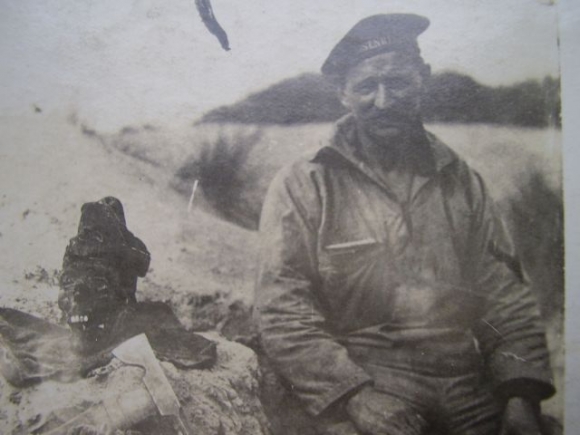

Above photograph is of a late 19th century or early 1900s (WWI) Kaiserliche Marine or KuK Kriegsmarine sailor performing a grisly task with his Boarding Ax or Enterbeil!
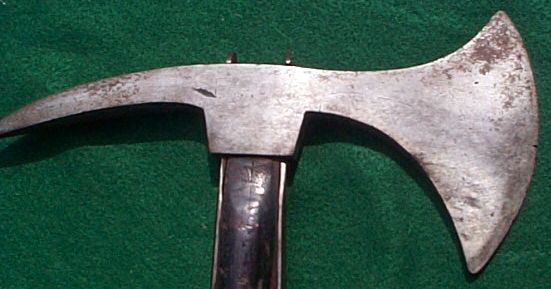
| Definitely of Scandinavian Origin. 18th Century Naval Boarding Ax in Perfect Museum Quality Condition, Well Preserved - Classical wide flaring blade and curved spike. Has a hand-engraved cross on the haft and the number 101 on the bottom butt with no other markings. Slight nick on the blade from possible battle damage, some worm holes, no other damage. Long langets with three equally spaced non-thru securing screws on each side. Turned haft with slightly raised ridge design to prevent hand from slipping with a round butt. |
 Click Photo! |
Length: 35" long Head: 11" long Blade: 5.25" wide Spike: 4 5/8 long. |
Sold! |
540 659 6209 |
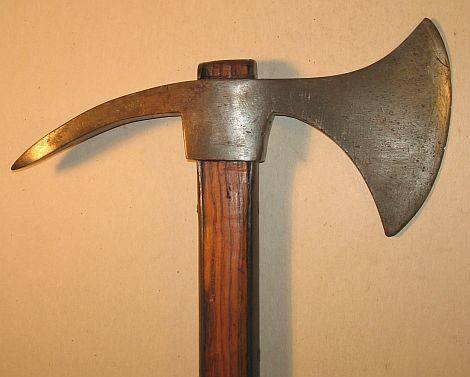
| 18th Century Swedish Navy Naval Boarding Ax in Perfect Museum Quality/Investment Grade Condition. Classical wide flaring blade and sharply curved spike. Has a stamped maker mark on the blade edge with no other markings. Some delamination on the blade edge and slight nick on the blade. No worm holes, no other damage. Long langets with equally spaced non-thru securing screws on each side. Turned haft with a round butt. |
 Click Photo! |
Length:25.5" long Head: 10.5" long Curved Blade: 5.25" wide Curved Spike: 4.5 long. |
|
540 659 6209 |
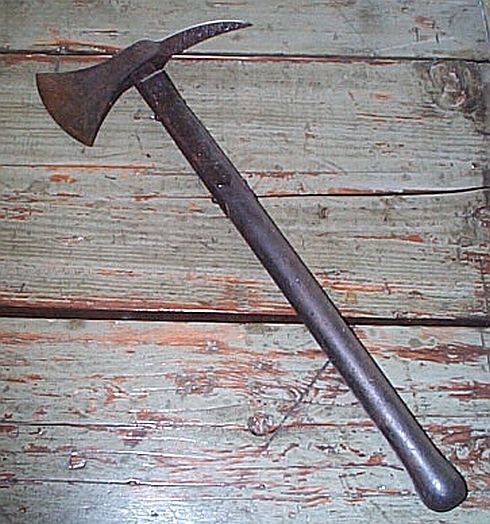
| Classic late 18th Century French Naval Boarding Ax in Excellent Condition as Illustrated and Described in "Boarders Away" pages 34 and 35. Remnants of the original blackended steel head and 23" wooden handle with knob. Blade has the classic French flare with just a curved beveled spike which is slightly thinner and more curved than either the later Model An IX or M1833 axes, though the 23" length is slightly shorter than what is found on the earlier M1786. |
 Click Photo! |
Overall Length: 23" long Head: 9.5" long |
|
|
| Classic early 19th Century French Naval Boarding Ax in Excellent Condition as Illustrated and Described in "Boarders Away" pages 34 and 35. This is the later model AnIX ca 1799-1801 as described and illustrated by Gilkerson as it has the shortened spike and 23" ovoid handle. Blade faces each have an arsenal inspection "anchor" stamp, one is larger than the other. |
 Click Photo! |
Overall Length: 23" long Head: 7.5" long |
|
|
| Classic early 19th Century French Naval Boarding Ax in Excellent Condition as Illustrated and Described in "Boarders Away" pages 34 and 35. This is the later model ANIX described and illustrated by Gilkerson as it has the shortened spike and 23" ovoid handle. Blade has the classic French flare with just a short beveled spike reminiscent of the later Model M1833. |
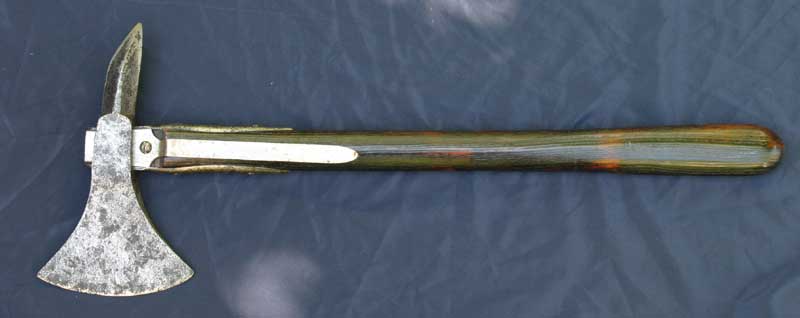 Click Photo! |
Overall Length: 23" long Head: 7.5" long |
|
|
| Museum Quality Condition. Classic early 19th Century Napoleonic Era French Naval Boarding Ax in Excellent Condition with French Navy "Anchor" Arsenal Marks Stamped On Both Sides of the Blade. As Illustrated and Described in "Boarders Away" pages 34 and 35. This is the later model ANIX described and illustrated by Gilkerson as it has the shortened spike and 23" ovoid handle. Blade has the classic French flare with just a short beveled spike. |
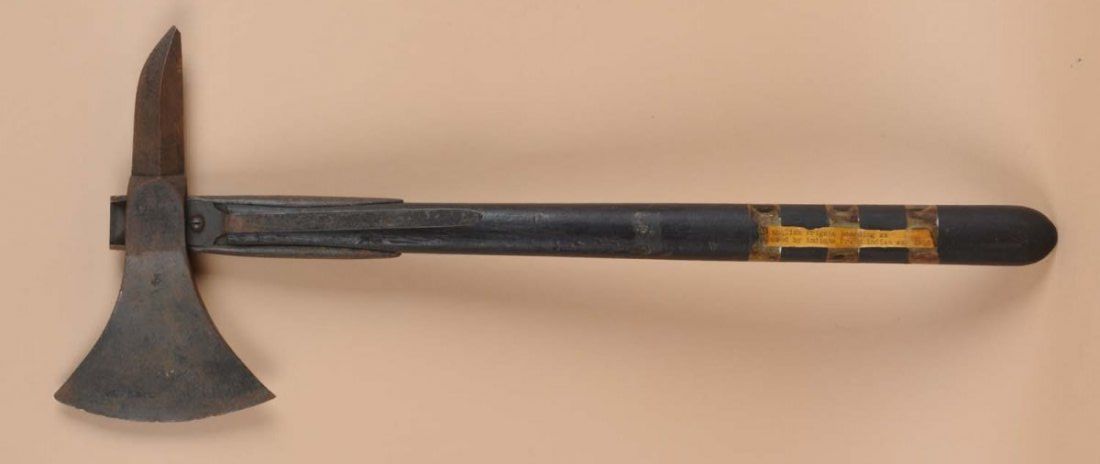 Click Photo! |
Overall Length: 23" long Head: 7.5" long Of particular interest is that this French Boarding Ax in some distant past museum or collection described it as being from a British Frigate and therefore a Royal Navy Boarding Ax, which it obvisouly is not. However it most likely was originally found on a British warship as a captured French Ax and put into the British Frigates small arms inventory as was the tradition in the late 18th and early 19th centuries. |
|
540 659 6209 |
| Classic mid 19th Century French Naval Boarding Ax in Excellent Condition as Illustrated and Described in "Boarders Away". Original blackened handle with knob butt. Ax head is stamped "538" on one side of the blade and with an "anchor" on the opposite side. |
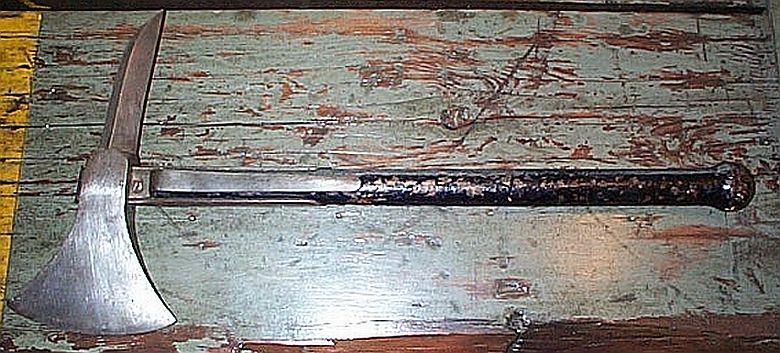 Click Photo! |
Overall Length: 23" long Head: 9.5" long |
|
|
| Well marked, rare, and in excellent condition British Royal Navy Boarding Ax Originally Found in Australia! Typical very early-mid 19th Century Napoleonic/War of 1812 style with slightly lobed langets and tomahawk head. Broad Arrow clearly seen along with Royal Crown Cipher ith initials "BO" below for Board of Ordinance. Ash handle with ball butt with signs of "scraping" which was used to clean the wood. |
 |
Total Length: 24.5" long Head: 8" long Blade: 2.5" wide Spike: 4" long. |
SOLD |
540 659 6209 |
| Classic 18th Century British Navy "Tomahawk" Style Naval Boarding Ax in Museum Quality Condition. Very crudely made which indicates "American Colonial" construction. The original turned handle has two sanded areas for a greater grip and with straight sided riveted langets in the mid-late 18th century style. Slightly curved blade with curved non-beveled spike. Marked with the name "A. LEWIS" on the wooden handle just below one of the langets. No other markings |
 Click Photo! |
Total Length: 28" long Head: 9" long Blade: 3.5" Spike: 4.5" |
|
540 659 6209 |
| The last of a breed and the age of sail! The Pattern P1859 was the last official British Royal Navy Boarding Ax established by the War Department. This particular boarding ax is in excellent museum quality condition, well marked, arsenal stamped and dated 1890. |
 Click Photo! |
Length: 23.5" long Head: 8.75" long Blade: 4.5" wide Spike: 2.75" long. |
|
|
| Rarer than Rare! Museum Quality, Investment Grade Condition. Marked with "US" on obverse blade. Ca 1800-1812. Langets are integral to the socket. Iron wedge clearly seen in socket eye securing the wooden oak or chestnut ball butted handle still retaining its black japanning. |
 Click Photo! |
Length: 22.75" long Head: 9.5" long Langets: 8.5" long. |
|
|
| Has the later Arsenal Modifications most likely performed at the New York Navy Yard (NYNY) with strengthening weld modifications on the socket along with handle or haft shortened to function more like a hand ax. Spike is the earlier tapering style with flatter 3/8" width. The last true boarding ax of the US Navy and used from the War of 1812, Mexican- American War, and lastly in the Civil War. This particular boarding ax is in very good condition, properly arsenal stamped and marked. |
 Click Photo! |
Length: 15.0" long Head: 10.00" long Blade: 2.75" wide Spike: 3.75" long. |
|
|
| This speciment has the later Arsenal Modifications most likely performed at the New York Navy Yard (NYNY) with the spike peened back hammer-like along with handle or haft shortened to function more like a hand ax. Spike is the later square style with thicker 1/4" width. The last true boarding ax of the US Navy and used from the War of 1812, Mexican- American War, and lastly in the Civil War. This particular boarding ax is in very good condition and properly arsenal stamped and marked. |
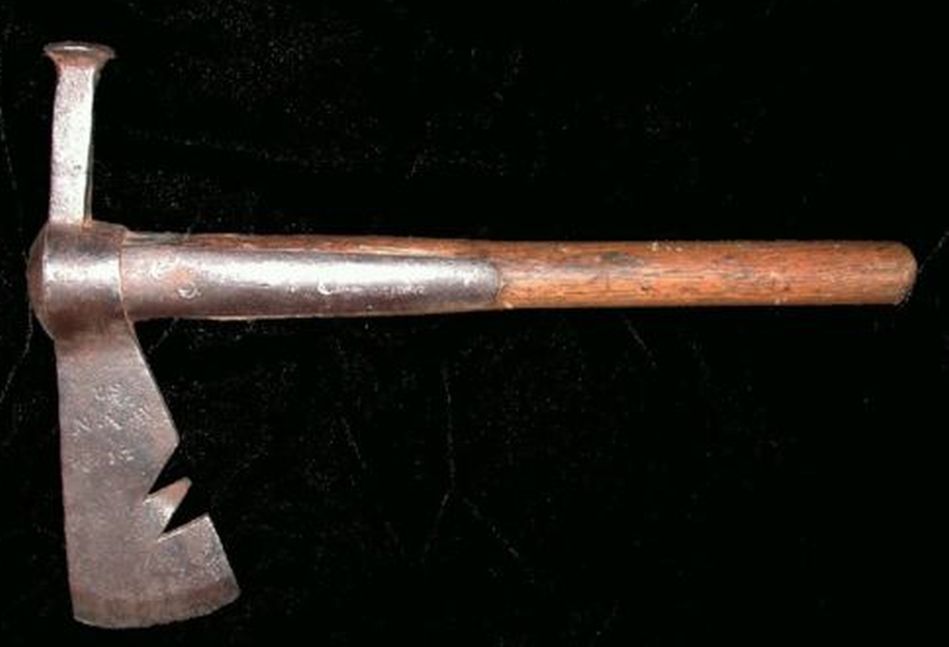 Click Photo! |
Length: 13.5" long Head: 8.75" long Blade: 2.75" wide Modified Peened Spike: 2.50" long. |
|
|
| Classic 18th Century Pole Ax of American, British or French provenance. Has stamped maker mark cartouche on blade of marching man beating a drum. While not naval or even military it's kewl and shows the blade design similar to a boarding ax. Also this type of ax was carried by most every British or American soldier during the Revolutionary War as a staple piece of equipment. |
 Click Photo! |
Total Length: 17" Head: 5 1/2" long Blade: 4 1/4" wide |
Sold! |
540 659 6209 |
| Classic 18th Century Sling Blade or Kaiser Blade with Maker Name ending in "..NNER" and either the number 7 or an > (arrow). Definitely a standard handforged blacksmith tool or weapon in that it has a handcrafted and turned handle, professionally attached rivets, and maker marked. |
 Click Photo! |
Total Length: 27" Blade and Langets: 13 1/2" long |
Sold! |
540 659 6209 |
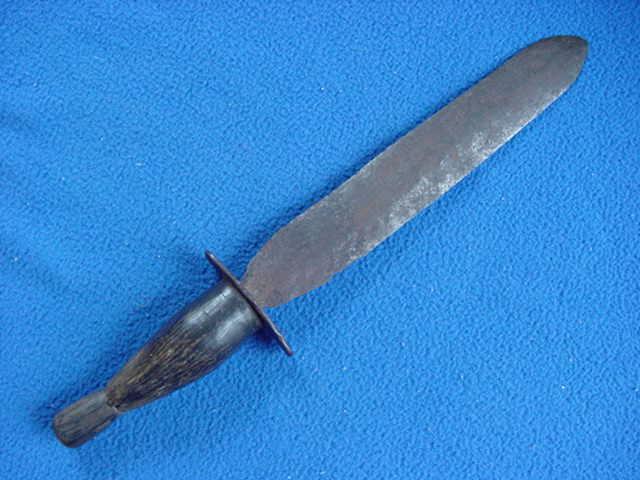
| Obtained direct from southern Alabama estate with military lineage to the American Revolution. Perfect and typical example of American Revolution-to-Civil War era Handcrafted Bowie Knive from a large rasp file. This type of homemade bowie knife using a large file was commonly found on Confederate soldiers! |
 Click Photo! Click Photo! |
16" Total Length, Blade: 10.25". Some pitting and rusting on blade consistent with age and the rasp file impressions left in the steel can still be clearly seen. Previous owners stated that this family heirloom was made and used by a family member during the American Revolution and later used by another family member while in the Confederate service during the Civil War. | |
540 659 6209 |
| Big and Heavy! Classic early 20th Century Russian or Soviet Ax Head with stamped Maker Mark, Hammer and Sickle. While this is not a Russian naval item we thought that it was a very kewl piece of history to have and have come to find a relatively rare one. This was obtained from a collector in Estonia! Remnants of Original Dark Gray-Green Paint. |
 Click Photo! |
Head: 8" long Blade: 5 1/2" wide weight: 3 lbs. |
|
540 659 6209 |
| Classic late 18th and 19th Century British Royal Navy Boarding Pikes in Museum Quality Condition with Original 91" and 92" staves or hafts. Photographic comparisons between American Federal Navy and various patterns and models of British Royal Navy boarding pikes, documenting stamped arsenal marks and royal ciphers. |
Click Photo! |
Edged Weapons for Sea Service British Royal Navy |
|
540 659 6209 |
| Classic late 18th and 19th Century American Navy Boarding Pikes in Museum Quality Condition some with original 87" staves or hafts. Photographic comparisons between the American Federal Navy Boarding Pikes and the various patterns or models of British Royal Navy boarding pikes, documenting stamped markings. |
Click Photo! |
Edged Weapons for Sea Service American Navy |
|
540 659 6209 |
| Excavated in/around Plattsburgh, NY. Hand forged hand-forged rolled-over socket for placement onto a pike, pole or spear, with a center ring. Unmarked and most likely used by American Foot Infantry, |
 Click Photo! Click Photo! |
Impressive 18" long, Blade is 11.25", Heavy! Some pitting and rusting on blade consistent with age. | Sold! |
540 659 6209 |
| Crudely yet effective trench spike! Excavated in/around Northern NJ. Hand forged hand-forged rolled-over socket for placement onto a pike, pole or spear, with a center ring. Unmarked and certainly used by American infantry as part of trench defense., |
 Click Photo! Click Photo! |
Typical Trench Spike: 8" long, Spike is 5".! Some pitting and even patina consistent with age. Treated with varnish sometime in the past to retard further rusting and deterioration. | Sold! |
540 659 6209 |
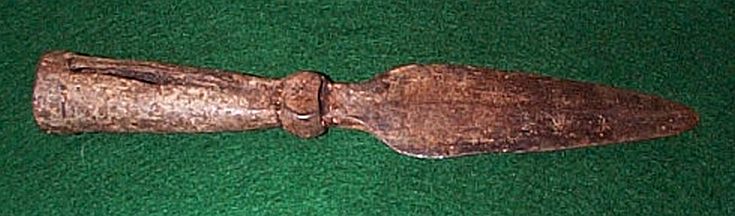
| Excavated in/around Northern NJ, Southern NY area along the Hudson River area. Blade sharpened on both sides, hand forged hand-forged rolled-over socket for placement onto a pike, pole or spear, with a center ring. Unmarked and certainly used by American infantry or possibly cavalry due to its smaller size and weight. |
 Click Photo! Click Photo! |
Typical Trench Spike: 10" long, Spike is 5.5".! Some pitting and even patina consistent with age. | Sold! |
540 659 6209 |
| Excavated in/around Lake Erie area in NY. Unmarked, yet not crudely made as one would expect from Colonial American manufacturer so this could most likely be of British Naval provenance. |
 Click Photo! Click Photo! |
10" long, Blade is 5" Slim, Low Profile! Some pitting and even patina consistent with age. Treated with varnish sometime in the past to retard further rusting and deterioration. | Sold! |
540 659 6209 |
| The Real Deal! Fully Restored Antique Trunks Like Sea Chests, Pirate Chests, Treasure Chests! |
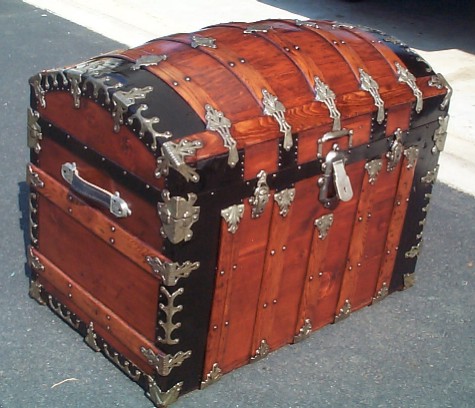 Click Here To Review Sample Engravings |
|
| Custom Designed, Handcrafted, and Hand Lettered in Caligraphy on your Antique Chest |
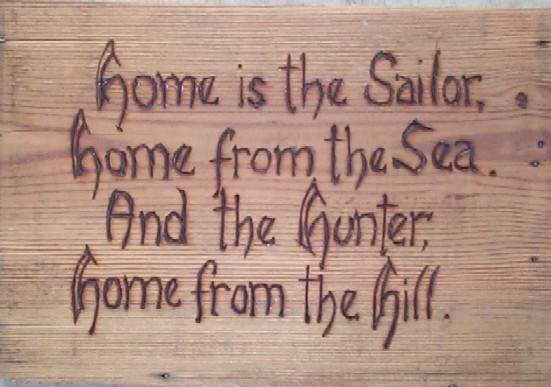 Click Here To Review Sample Engravings |
|
| Customer Photographic Examples of our Antique Trunks Being used as a Military or Naval Retirement Shadow Box and Storage Chest!! |
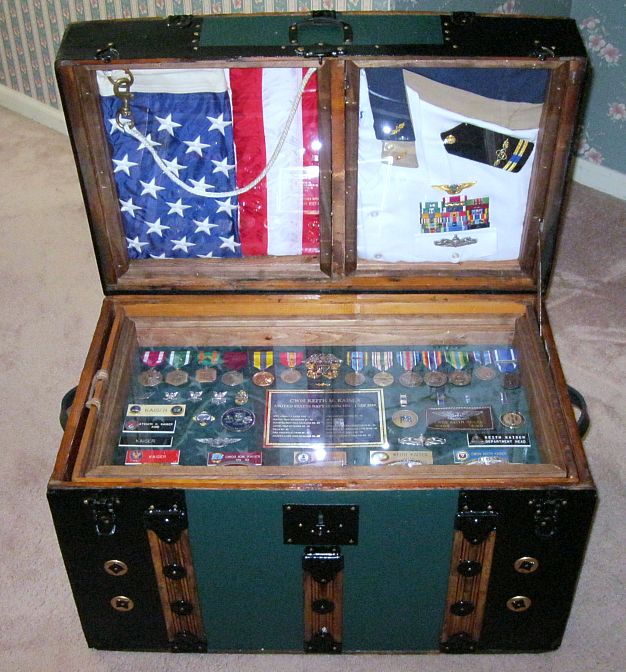 Click Here for Sample Shadow Box Photographs From Customers |
|


 Or Click HERE to return to The Pirate's Lair Home Page and Gangplank!