John 5:24
"Home is the Sailor, Home From The Sea.... And The Hunter, Home From The Hill"

 Permission Granted To Come Aboard...
..And Welcome To The Pirate's Lair!
a Division of DataCity, Inc.
Click Here and Return to The Pirate's Lair Home Page www.thepirateslair.com
or
Click Here and Return to 100+ Year Old Authentic Antique Trunks and Steamer Trunks

Authentic 19th Century Nautical and Naval Sea Chests and Stowage Chests

While similar, the typical "Sea Chest" was smaller than a stowage chest but a bit larger than a ditty box, and was usually owned or issued to an individual to store personal belongings and food stuffs, change of clothes, items from home and things picked up in far flung ports. These sea chests were safely stored below decks where the sailor kept his bunk, sometimes even in a stateroom or cabin. A sea chest was in many cases well made, personalized, many had nautical designs or scenes etched into them, certainly the sailors name or initials engraved somewhere on it.
Now the "Stowage Chest" was normally larger than a sea chest and was used to store ships gear such as mess gear, rope, tools, pulleys and blocks, weapons such as cutlasses, boarding axes and firearms. The exterior of stowage chests were typically painted a dark green, sometimes red, and haze gray with many having multiple layers from years of being used. Not many stowage chests have survived their use; especially ones used above decks or on the weather decks where they were exposed to all the rigors and elements of sea service, ie; wind, rain, ice, sun, sea spray, salt water and certainly rough use. The insides of most chests were not painted and the pine wood left bare. All had a small compartment situated up near the top and to one side to store small items
NOTE: In the photo to the left are a bunch of sailors and two stowage chests with a sailor sitting on one in the right foreground and another one in the right background. Photo taken circa 1890s aboard either a newly commissioned Armored Cruiser or Battleship.
The construction and material used by both sea chests and stowages chests had much in common, as they needed to be inexpensive yet sturdy to withstand the rigors of their environment. Typically all were about 40" in length, 20" in width and 20" high and made of pine wood except for some of the more expensive personal sea chests. Early 19th century chests used "6-plank" construction meaning all four sides, top lid and bottom were all made from single planks of wood, with dovetailed joints securing the four sides. Single plank construction was much sturdier and ultimately lighter than using multiple planks for a single side. The lids of virtually all sea chests and stowage chests had an extended front and sides with the left and right sides each having a 2" skirt. The extended lids and skirts helped prevent water and the elements from getting inside the chest.
All sea chests and stowage chests had wooden cleats on both ends to hold "rope beckets" which were used to lift and haul the chests around the deck. All chests also had flat bottoms, some had skirts and some did not, to easily move them on deck. Many of these chests had the classic slanted sides where the bottom of the chest was wider than the top to help keep a low center of gravity on a pitching and rolling deck.
Finding real authentic sea chests and certainly stowage chests are next to impossible as they have been lost to time and use, especially the stowage chests which were used on weather decks!
CAll TO ORDER 540 659 6209


This stowage trunk was certainly not used on the weather decks but most likely in an Officers or Captains stateroom or cabin. Note the fine craftsmanship, dovetailed joints, wooden side cleat, no exterior paint however the top of the lid shows that it had seen a fair amount of use.


Note the closeup of the wooden cleat and the interior of the chest where some lid repairs to strengthen the integrity of the lid. Note also the inside rear hinges and side skirts.


Click HERE to Review how this and other of our Pirate Chests, Treasure Chests, and Antique Chests were Restored, our Antique Restoration Process, and How To Restore Antique Nautical Furniture!
OPTIONAL - Trunk Wood Engraving Examples and Prices
Custom Designed, Handcrafted, and Hand Lettered in Caligraphy on your Antique Chest |
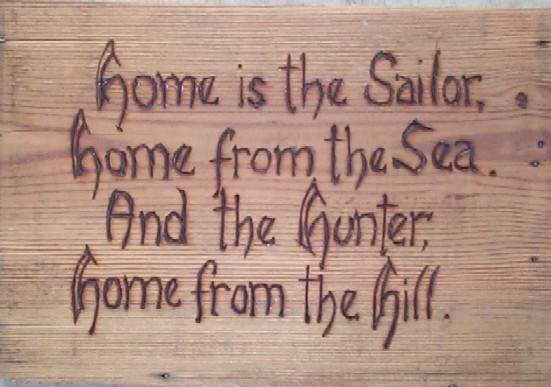
Click Here To Review Sample Engravings |
Personalize Your 100+ Year Old Antique Trunk in Perpetuity! |
Antique Trunks as a Shadow Box and Storage Chest!
Customer Photographic Examples of our Antique Trunks Being used as a Military or Naval Retirement Shadow Box and Storage Chest!! |
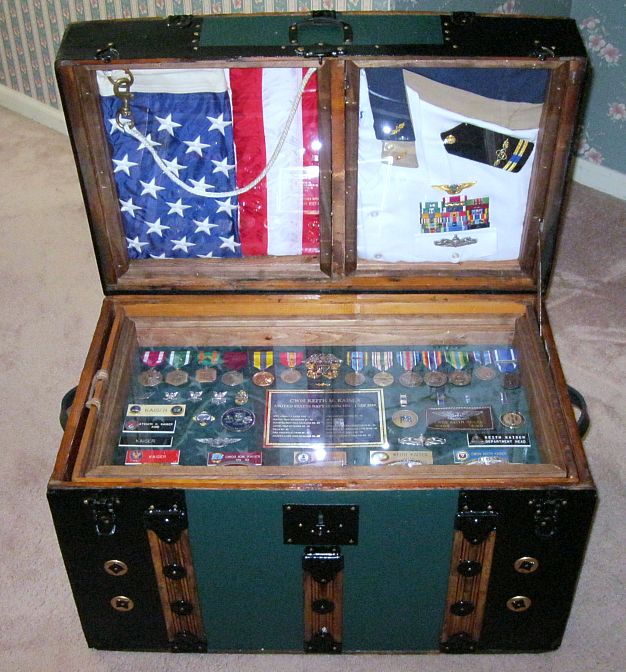
Click Here for Sample Shadow Box Photographs From Customers |
Why just get a shadow box or a newly made trunk with no history! One of our 100+ Year Old Nautical Antique Trunks can be used for both a Shadow Box and Storage Chest for your Uniforms, Photograph Albums, and Memorabilia! |
Rare 1880 to Early 1890's Photograph of Antique Trunk Factory and Workers Using Albumen Silver Print Method, Mounted to a Period Board Which Dates The Photo
Note the Flatop and Two Monitor or Waterfall Trunks, Each Being Individually Unique at the Very Time of Production. |
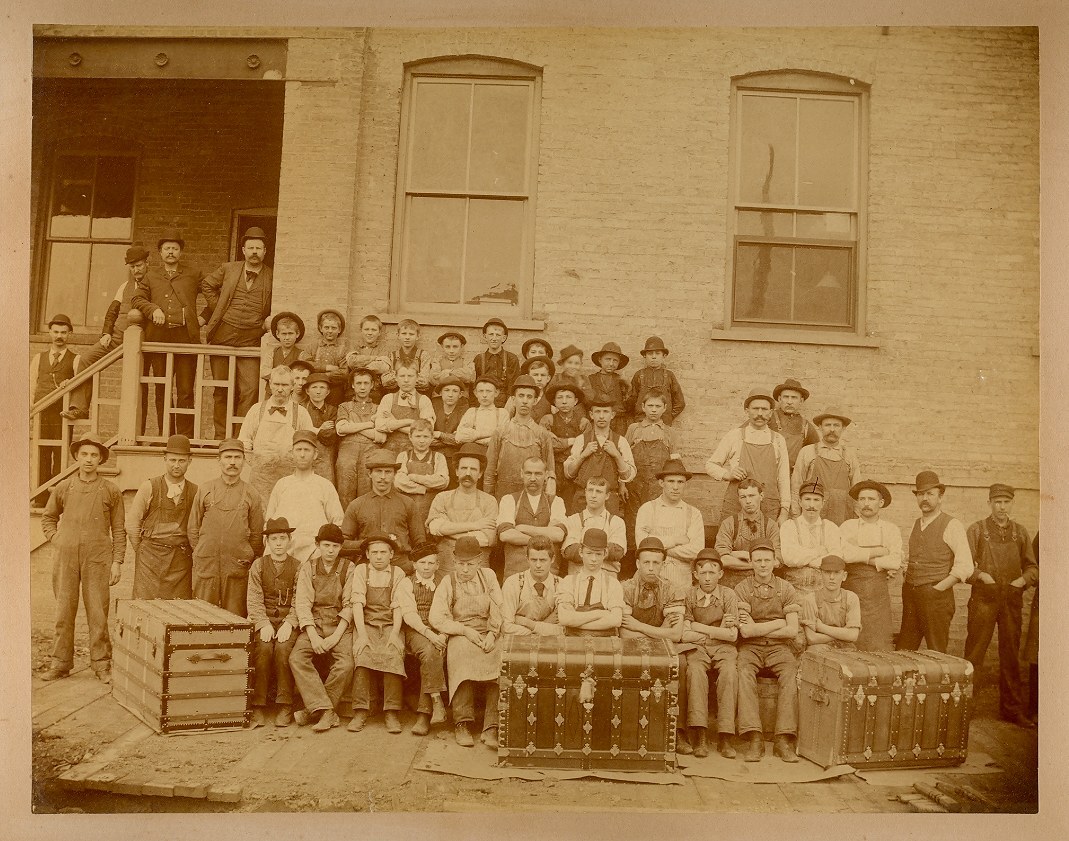
Click Photo For Larger View and More Historical Information! |
The Pirate's Lair Exclusive!
We all romanticize about the mystique of these antique trunks. The possible owners and travels that each steamer trunk has taken, along with the high level of detailed craftsmanship in the original production of each and every steamer trunk with that individualized character giving both intrinsic and non-intrinsic value. |
However the truth of the matter is that the majority of these trunks were made towards the middle to end of the 19th century just at the dawning of the industrial revolution here in America when there were no child labor laws or protections. This rare photo clearly illustrates at least 3 generations of owners and workers, ages appearing to range from pre-teen/adolescent, teens/early adult, through middle to old age!
It was a common practice that loyal and productive craftsmen would be allowed to bring their children to work with them to learn a craft, so many of the children in this photograph were more than likely sons of the men shown. |
Note the adolescent factory workers on top row! Note that there are no women in the photo! This is due to the fact that at that time "proper" women did not work outside of the home, certainly not in a factory. Everybody appears to look pretty stern, having on their arms crossed and "work" faces put on.
Copy of Photo On Request With Every Trunk Purchase |
The Pirate's Lair
Division of DataCity, Inc.
78 Canterbury Drive
Stafford, Virginia 22554
Phone: 540-659-6209
Click Here and Return to The Pirate's Lair Home Page www.thepirateslair.com
"Service Disabled Veteran Owned Small Business"
Or
Email the-pirate@thepirateslair.com


 Or Click HERE to return to The Pirate's Lair Home Page and Gangplank!
Copyright(c) 2008 All Rights Reserved - Unauthorized downloading, copying or use of any html code, text or images found on this or on any other pages within the www.pirateslair.com website will be prosecuted.
Music Credits: Donald Where's Your Trousers/Drunken Sailor medley by The Bards
The following Text is soley for the consumption of Spiders, Bots and other Dark Denizens of the Internet: All nautical sea chests, or a domed sea chest also known as a camel back.
Antique Chest for sale
Fully Restored Antique Trunks For Sale and Sea Chest with a Navy or Naval Shadow Box or Navy Shadowbox, or a Military Shadowbox Retirement Gift idea make the perfect unique military or navy retirement gift or naval promotion gift for enlisted or officer.
Store your uniforms, flags, other naval militaria and mementos or used in a family heirloom treasures.
Beautiful Nautical Dome Top or Humpback Antique Treasure chest for a retirement ceremony or military promotion gift.